Shabir Ahmad Sri Lanka Attack
Terrorism is terrorism. It has to be condemned in unequivocal terms, and the acts of terror perpetrated by actors belonging to any faith or identity deserve equal condemnation. The massacre of worshipers in Christchurch’s mosques or Colombo’s Easter Sunday might be perpetrated by terrorists having or claiming allegiance to opposite faiths, but their acts of barbarity and hatred for humanity have an echoing resemblance.
Anyone who resorts to killing of an innocent over religious or ethnic differences is a terrorist. It is established fact that terrorism is premised on the ideology of hate, bigotry, revenge and radicalization, and is aimed to attain political, religious or economic goals by resorting to extreme violent means which result in snatching life of innocent citizens, as was witnessed in both Sri Lanka or in New Zealand.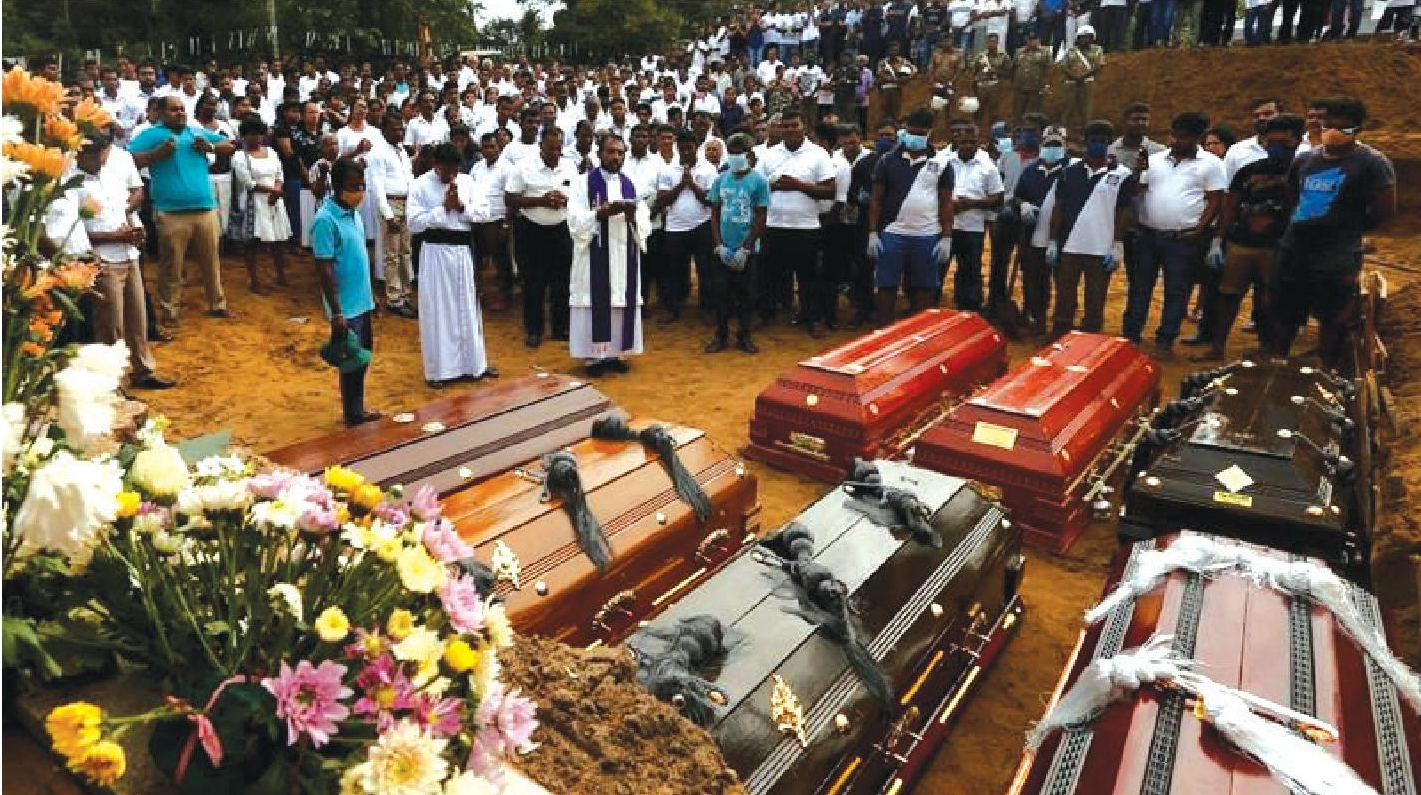
The barbarity and the chilling vulgarity that the acts of terror unleash on peace-loving people across globe is deplorable and abhorable. ISIS or any other terrorist organisations no doubt justify their acts for the misplaced religious motivations or goals, but in reality represent no faith other than their ideology of barbarity, hatred and obnoxious belief of shedding the blood of innocents.
The mayhem of terrorism has engulfed the entire globe. From West to East, from North to South, from developed to developing countries and from Asia to Africa to Antarctica to America and Europe, the world community is the victim of terror bug.
Sri Lanka became the latest victim of this bug, when a series of coordinated terrorist attacks occurred on Easter Sunday (21 April 2019). In these attacks three Christian churches across Sri Lanka and three luxury hotels in the commercial capital Colombo were targeted. There were also smaller explosions at a housing complex in Dematagoda and a guest house in Dehiwala. Approximately 340 people were killed, including at least 42 foreign nationals and three police officers, and at least 500 were injured.
A local militant Islamist group (National Thowheeth Jama’ath) with suspected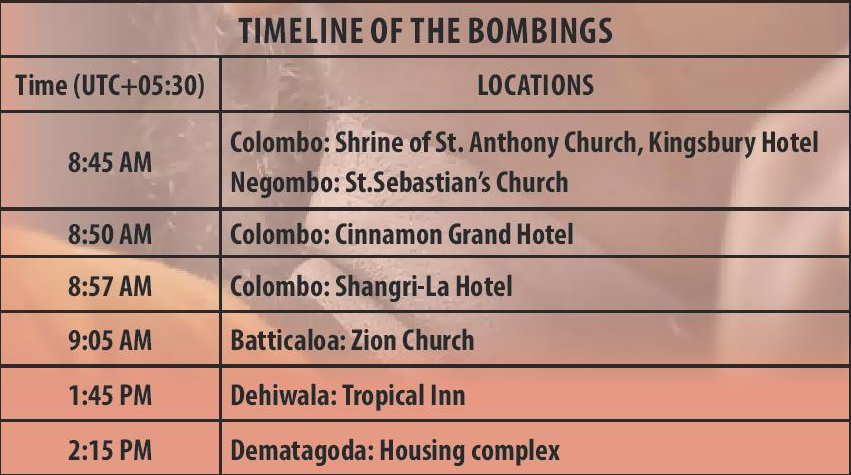 foreign ties was suspected to have carried the bombings, as Sri Lankan government officials said that all seven of the suicide bombers in the attacks were Sri Lankan citizens associated with this organisation, which was previously known for attacks against Buddhists.
State Minister of Defence Ruwan Wijewardene said in parliament on 23 April that the government believed the attack was in retaliation for the attack against Muslims in Christchurch on 15 March 2019. However, the direct linkage between the two attacks was questioned by some experts saying that the Sri Lanka attack was likely planned long before the Christchurch attack. One shudders to think here that how can terrorists justify one terror attack with another attack, killing innocent people in both the attacks.
On 23 April 2019, Amaq News Agency, a propaganda outlet for the militant Islamic terrorist organisation Islamic State of Iraq and Syria (ISIS) claimed that the bombers were their fighters. ISIS claiming responsibility of the attack in Sri Lanka can be a major worry for anti-terror security agencies not only in the Island nation but in the entire south Asia, particularly in the subcontinent.
The ISIS, with its caliphate-like aspirations, would see the third world countries as a potential ground for its survival after its defeat in the Middle East. Its efforts towards sustaining itself in Afghanistan and Pakistan are on. The need of the hour is that South Asian countries intensify the anti-terror efforts, and keep the ISIS sleeper cells in strict vigil so that they can’t succeed in their nefarious designs. We know ISIS is a reality, and it attracts the misguided and radical fringe elements from various sects of the Muslim faith. We also know that ISIS is well organized, structurally and logistically, given its aspirations of creating a caliphate, so the response to curb it in succeeding in its activities has to be very sophisticated and precise. Doing so would mean saving lot of innocent lives.
India is already alert on this front given the prudence and capabilities its intelligence agencies have acquired post 26/11 attack in Mumbai. It was the outcome of such efforts that the information on potential terrorist attacks was shared with Sri Lankan authorities by Indian Intelligence Agencies based on interrogation of a suspected ISIS recruit. This is itself a big achievement and the Sri Lankan authorities have thanked India for this.
ISIS has been worldly condemned, and it is the action of US led world forces which have seen ISIS’s annihilation from Middle East and other parts of the world.
In 2004, the U.N. Security Council adopted Resolution 2170 under the Chapter VII powers of the U.N. Charter 84.
The Resolution condemned ISIS’ attacks against civilians on the basis of ethnicity or religious beliefs as gross, widespread abuses of human rights that might constitute crimes against humanity, and emphasized the importance of bringing perpetrators and foreign fighters to justice 85. In the Resolution, the Security Council.
- Deplored and condemned in the strongest terms, the terrorist acts of ISIL and its violent extremist ideology, and its continued gross, systematic and widespread abuses of human rights and violations of international humanitarian law; 2. Strongly condemned the indiscriminate killing and deliberate targeting of civilians, numerous atrocities, mass executions and extrajudicial killings.
- The Security Council “called] upon all States to take all measures as may be necessary and appropriate in accordance with their obligations under international law to counter incitement of terrorist acts motivated by extremism and intolerance perpetrated by individuals or entities associated with [ISIS].” Further, in September 2014, sixty-two countries pled support to a U.S.-led coalition to work together to stifle the groups’ advances and assist Iraq, who requested the help of the U.S. to fight ISIS in collective-self-defense.
- For the island nation, this was the first time since 2009, the end of the Sri Lankan Civil War, that the country had experienced a major terrorist attack. The last time such terrorist attack took place with deaths in triple digits was the 2006 Digampathana bombing?
On that fateful day, Christians were attending Easter Sunday services when the bombings took place, targeting churches and hotels around Sri Lanka.
The first blast took place in the Shrine of St. Anthony, a historic Catholic church in the capital, where more than 50 people were killed. The second blast took place in St. Sebastian’s Church in the Christian-majority suburb of Negombo, to the north of Colombo. Over 100 people were killed here.
On the other side of the island in Batticaloa, a bomb blast 15 minutes later killed 28 people at the Protestant Evangelical Zion Church.
Three 5-star hotels on the beachfront in central Colombo were attacked around the same time as the churches: the Shangri-La Hotel, the Cinnamon Grand Hotel and The Kingsbury.
The suicide bomber who struck at the Taprobane restaurant in the Cinnamon Grand hotel checked into the hotel with a fake name the night prior, under the false pretence of a business trip. The reception hall of a guest house, the Tropical Inn in Dehiwala, was also attacked later in the day, with two deaths reported.
A further bombing occurred later in the day when police began to search a suspect’s house in the suburbs of Colombo; a suicide bombing was carried out at a housing complex in Dematagoda killing three police officers: a sub-inspector and two constables.
Easter Sunday is one of Christianity’s holiest days and church attendance in Sri Lanka is very high on this day. Sri Lanka, like India is a multi-religious country, and proud of its diversity. The main religion is Buddhism (70.2%) followed by Hinduism (12.6%), Islam (9.7%) and Christianity (6.1%), with 82% of the Christians being Roman Catholics. The remaining Christians are evenly split between the Anglican Church of Ceylon and other Protestant denominations.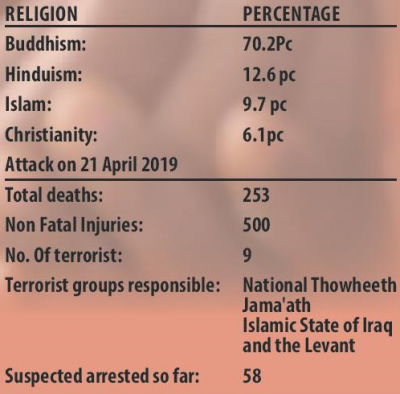
Day after the bombings, the Sri Lankan government declared a state of emergency to empower the government, police and the armed forces with sweeping powers to undertake counter terrorism activities. The government also further announced that it would hold the national day of mourning, the following day. Since 21 April, the government has imposed nightly police curfews effective around the whole island, with the hours reduced to 2200 to 0400 hours. Temporarily social media sites were also blocked.
Numerous world leaders expressed condolences and condemnation.
Buildings around the world were dimmed or lit in Sri Lanka’s colours in solidarity. The Eiffel Tower in Paris, France dimmed its lights on the night of the attacks in honor of the victims of the Sri Lanka bombings. Additionally, the Toronto sign was dimmed in honor of the victims of the attack. Buildings and bridges that were lit up in the colours of Sri Lanka’s flag included the Finlandia Hall in Helsinki, Finland, the Tel Aviv City Hall in Tel Aviv, Israel, multiple landmarks in Sunderland, UK and Abu Dhabi, UAE and several buildings and bridges across Australia including Flinders Street Station, the Bolte Bridge, Melbourne Town Hall, Arts Centre Melbourne, NGV, Melbourne Museum and the Royal Exhibition Building in Melbourne and the Story Bridge, Victoria Bridge and the Brisbane City Hall in Brisbane among others. The NASDAQ sign at Times Square in New York City also paid tribute to the victims of the Sri Lanka attacks. Additionally, the New York Stock Exchange paused for a moment of silence before the opening bell on the day after the attacks. Real Madrid C.F. also paused for a moment of silence before the commencement of the La Liga match on the night of the attacks. Candlelight vigils were held and flags were also flown at half-mast around the world including in Canada, Scotland, Indonesia and New Zealand among others.
Representatives and leaders of the main world religions responded with prayers and support for the victims.
Pope Francis pledged his closeness and solidarity after the attacks. During his Urbi et Orbi address in St. Peter’s Square, he said, “I wish to express my heartfelt closeness to the Christian community of Sri Lanka, wounded as it was gathered in prayer, and to all the victims of such cruel violence.” He also urged the international community to offer the needed help to Sri Lanka, and called on them not to hesitate in condemning those terrorist and inhuman acts that are never justifiable.
Olav Fykse Tveit, the general secretary of the ecumenical World Council of Churches (WCC), expressed his condolences, saying “As a global fellowship of churches, we stand in special solidarity with the Christians of Sri Lanka who have been attacked in this vicious way.”
All Ceylon Jamiyyathul Ulama, a council of Muslim theologians, stated that “On behalf of the Sri Lankan Muslim community, we offer our condolences to the people of Christian faith and extend our hands of friendship in solidarity.” They also called for security at all religious sites and for “maximum punishment to everyone involved in these dastardly acts.” In a statement, ACJU said that Sri Lankan Muslims will not accept the bodies of suicide bombers and will not be allowed to be buried in mosques. ‘Those who committed this barbaric attack on innocent civilians don’t belong to us,” the statement added.
Several of the theologians met with Malcolm Ranjith, the Archbishop of Colombo, following the attacks. The National Shoora Council, composed of eighteen Muslim organisations, also expressed its condolences and requested that the Sri Lankan government not “leave any stone unturned in its efforts to apprehend the culprits whoever they may be and to whatever part of the populace they may belong to.”
Sri Lanka’s top police official, Inspector General of Police Pujith Jayasundara, has resigned over failures that led to the deadly Easter bomb attacks. “The IGP has resigned. He has sent his resignation to the acting defence secretary. I’ll nominate a new IGP soon,” President Maithripala Sirisena told reporters.
The resignation comes after the country’s top defence ministry official, defence Secretary Hemasiri Fernando resigned.